
What's inside
As an Amazon Associate I earn from qualifying purchases. This post may contain affiliate links at no extra cost to you.
The best drone for travel is decided less by its camera than by its passport. A travel drone lives under three jurisdictions at once — the aviation rules of every country on the itinerary, the airline’s battery policy in the cabin, and the simple physics of a bag that was already full — and the drone that wins is the one that passes all three while still shooting footage worth the carrying. This guide compares the real travel drones worth buying in 2026, and it is organised around the number that has reshaped the entire category: 249 grams. Below that weight, the world’s major regulatory systems treat a drone most gently — registration is lightest or waived for recreational use in several major jurisdictions, and the sub-250g class has become the traveller’s fleet almost by law. But the law varies by country, changes without consulting your itinerary, and is the traveller’s own responsibility to check for every destination, because the drone that is a toy at home can be contraband at the border. This guide will repeat that sentence in several forms. It is the most important specification in the article.
Understand what the weight classes buy and cost. The sub-249g drones fold to the size of a water bottle, carry cameras that have become genuinely excellent — 4K video, capable stills, intelligent flight modes — and ask the least of regulators and bags alike; their honest taxes are wind, where a light drone works harder and sometimes must wait for calmer air, and battery endurance measured in the tens of minutes rather than the hour. The mid-size class around 700 grams buys a bigger sensor, a second or third lens, obstacle sensing in every direction, and wind manners for the exposed coast — at the price of registration in most jurisdictions and a bag that notices it. The flagship class is the transported traveller’s instrument, for the dedicated aerial trip where the drone is the point. Most travellers, most of the time, belong in the first class, and this guide’s leader lives there — but the traveller whose footage is the trip’s purpose should read the mid-size reviews with the seriousness they deserve, because no mini has yet repealed the physics of a larger sensor.
The legal frame deserves its full weight before a single model is praised, because drones are the most regulated gadget a traveller can pack. The universal rules rhyme across jurisdictions even where their details differ: fly below the altitude ceiling — commonly around 120 metres above ground; keep the drone in sight; never fly over crowds, near airports, or in the national parks and protected areas that widely prohibit drones entirely; respect privacy as law and as courtesy; and register, certify, or label as the destination requires, which in the European Union means operator registration and an online course for most use, in the United States means recreational rules under the FAA with registration tied to weight and purpose, and in a long list of countries means permits applied for in advance or an outright ban on bringing the drone in at all. Some destinations confiscate unregistered drones at customs. None of this is a reason to leave the category; it is a reason to travel it like a professional: research each destination’s current rules from its own aviation authority before departure, carry the paperwork, and accept the places where the drone stays in the bag as part of the trip’s texture. The footage is never worth the fine, the confiscation, or the headline.
Our Top Picks
What Makes the Best Drone for Travel
Weight, Folded Size, and the 249-Gram Line
The traveller’s first specification is the all-up weight, printed by the maker and decisive at borders: under 249 grams is the golden band in the major systems, and every gram of accessory discipline — the lightest case, the batteries counted rather than hoarded — protects it. Folded size is the second: the mini class disappears into a jacket pocket or a camera bag’s corner, which is why it gets carried on the unplanned evening when the light turns golden, while the mid-size drone is a deliberate packing decision that earns its space on deliberate days. Judge the kit, not the drone: controller, spare batteries, charging hub, spare props, and the case are the travelling object, and the makers’ fly-more bundles exist because the kit is the product. A drone whose kit fits the bag you already travel with will fly ten times more often than a superior drone whose kit needs its own luggage — the oldest law in travel photography, applied to the sky.
Camera, Sensing, and the Footage Test
Travel footage is judged by what survives the trip home: the orbit over the cove, the reveal across the old town’s roofs — where flying is legal, which in old towns it often is not — the stills that hold a wall print. The mini class’s cameras now shoot 4K at useful frame rates with colour profiles a colourist can grade, and their gimbals hold the horizon like instruments costing far more a few years ago. Obstacle sensing divides the classes honestly: the flagship minis sense in all directions, the budget minis sense downward or not at all, and for the traveller flying in unfamiliar terrain — trees, cliffs, architecture — sensing is the feature that brings the drone home, which makes it a travel feature of the first rank rather than a luxury. Tracking modes that follow a hiker, a cyclist, or a boat turn the solo traveller into their own film crew, within the rules of the airspace and the sight-line rule that never sleeps. Buy the camera for the footage you actually make: the social clip and the family film are served completely by the minis; the professional deliverable argues for the bigger sensors above them.
Batteries, Charging, and the Airline’s Rules
Flight time is published in still air by optimists, and the traveller plans on less — wind, cold, and altitude all spend the battery faster, and a prudent pilot lands with a reserve rather than a hope. The travelling system is therefore batteries in the plural: two or three, rotated through a charging hub, topped from USB-C where the model allows — a feature that has quietly revolutionised travel droning, because the drone now charges from the same power bank and hotel adapter as the phone. The airline’s law is absolute and simple: lithium batteries travel in the cabin, never in checked baggage, within the capacity limits every drone battery here comfortably meets, with terminals protected and the count kept reasonable and declared where an airline asks. Pack the batteries in the hand luggage, the drone itself wherever the airline prefers, and the paperwork with the passports. The traveller who treats the battery rules as part of the flight plan never has the airport conversation that ruins a departure.
Quick Comparison: Best Travel Drones Compared
| Travel Drone Model | Best For | Key Specs | Typical Price Range | Rating |
|---|---|---|---|---|
| DJI Mini 4 Pro | Best drone for travel overall | Under 249g, 4K/60 HDR video, omnidirectional obstacle sensing, up to around 34 minutes per battery as published | $750 – $1,100 | 4.8 / 5 |
| DJI Flip | Best for vloggers and solo travellers | Under 249g, 4K/60 HDR, full-coverage propeller guards, palm takeoff and subject tracking as published | $440 – $650 | 4.6 / 5 |
| DJI Air 3S | Best mid-size for serious footage | Around 724g, dual cameras with 1-inch main sensor, up to around 45 minutes as published, all-direction sensing | $1,100 – $1,600 | 4.7 / 5 |
| DJI Neo | Best ultralight budget starter | Around 135g, 4K video, palm takeoff, propeller guards, shortest flight time in class as published | $200 – $330 | 4.3 / 5 |
| HoverAir X1 PRO | Best self-flying camera | Under 200g class, autonomous follow modes, 4K video, folds flat for pockets as published | $500 – $700 | 4.3 / 5 |
| DJI Mini 4K | Best budget mini | Under 249g, 4K video, basic sensing, the entry price of the serious mini class as published | $300 – $450 | 4.2 / 5 |
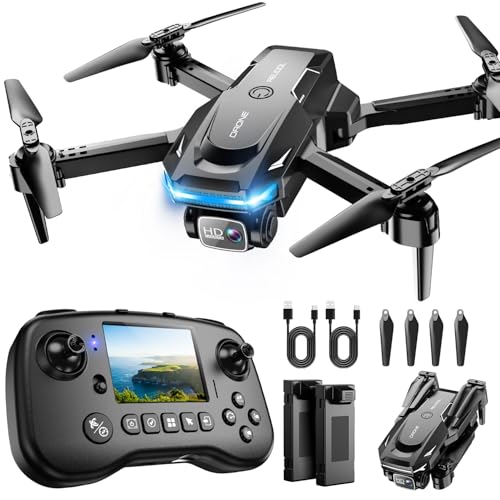
Drone with Camera, Screen on Controller Remote Control Quadcopter FPV Drone | Drone with Built-in Screen Controller for Beginners, Foldable, Gesture Control, 3D Flip, One-Key Start, and Emergency Stop
As an Amazon Associate we earn from qualifying purchases. Product prices and availability are accurate as of the date/time indicated.

HOVERAir X1 Drone with Camera, Follow-me Drone with Self-Flying Mode | Foldable Mini Drone with HDR Video Capture, Palm Takeoff, Intelligent Flight Paths, Hands-Free Control Black (Combo)
As an Amazon Associate we earn from qualifying purchases. Product prices and availability are accurate as of the date/time indicated.

Drone with Camera for Adults, 2K HD FPV Drones with Upgrade Altitude Hold, One-Key Take Off/Landing, Speed Adjustment, Headless Mode, 2 Batteries, Toys Gifts for Teen Boys Girls, Beginner
As an Amazon Associate we earn from qualifying purchases. Product prices and availability are accurate as of the date/time indicated.
Ratings are editorial assessments for travel use, based on the makers’ published weights, cameras, flight times, and sensing specifications, and value at typical prices. Prices are typical retail ranges for the drone alone or common bundles as sold. Published flight times are maximums in ideal conditions; real travel flying returns less. Regulatory treatment of every model varies by country and must be verified for each destination, as this guide’s legal section requires.
Best Drones for Travel: The Six Reviewed
1. DJI Mini 4 Pro – Best Overall
The Mini 4 Pro is the travel drone perfected to date: under the golden weight with a camera that shoots beautiful 4K, obstacle sensing in every direction, intelligent tracking and shot modes that make a solo traveller look crewed, and batteries that charge by USB-C in a hub that fits the wash bag. It is the drone this guide hands to the traveller who wants the question closed — carried everywhere because it can be, flown often because it is there, and legal in the most places because of the number on its scale. Its price is the class’s ceiling and its value is the class’s argument. If one drone in this table is the default recommendation of the decade, it is this one.
2. DJI Flip – Best for Vloggers
The Flip folds its propeller guards into its design and its philosophy into its name: a drone for the creator who is also the subject, taking off from a palm, tracking a face, and folding away like a gadget rather than an aircraft. Its camera matches the mini class’s standard and its guards forgive the indoor-adjacent, close-quarters flying its parish involves — where local rules allow it, as always. For the travelling vlogger it removes the last friction between seeing the shot and having it, which is a creative feature no specification captures.
3. DJI Air 3S – Best Serious Footage
The Air 3S is the traveller’s step into professional light: a one-inch main sensor and a second telephoto camera, flight times that let a location be worked rather than sampled, and sensing and transmission of flagship grade — at a weight that registers in the world’s systems and a size that claims its corner of the bag. For the photographer whose aerial work is portfolio and product, it is the smallest drone that never apologises, and its owners plan trips around it the way photographers once planned around a tripod. That planning includes the paperwork, which this class always includes.
4. DJI Neo – Best Ultralight Starter
The Neo weighs about as much as the phone it obeys and costs the least in the serious conversation: palm takeoff, guarded props, honest 4K for the social film, and a flight time that teaches economy the way a small fuel tank teaches driving. It is the starter drone and the second drone — the one thrown in the bag when the Mini’s kit feels like commitment — and for the traveller unsure whether the sky is for them, it is the cheapest honest answer the category offers. Its limits are its size’s, stated fairly and forgiven at its price.
5. HoverAir X1 PRO – Best Self-Flying Camera
HoverAir’s machine removes the pilot from the equation almost entirely: launch it, choose a follow mode, and ride the bike or walk the ridge while it films, a flying cameraman in a folding package that slips into a jacket. Its footage serves the action traveller’s film beautifully within its modest range and endurance, and its autonomy is bounded by the same sight-line and airspace rules as every drone here — the pilot remains legally present even when their hands are free. For the solo athlete-traveller, it is not a drone purchase. It is a crew hire, at a drone’s price.
6. DJI Mini 4K – Best Budget Mini
The Mini 4K carries the golden weight and a real 4K camera at the entry price, trading away the flagship mini’s sensing and refinements. Its parish is the traveller who flies carefully in open places, learns the craft on a forgiving budget, and wants the regulatory gentleness of the class without its flagship ticket. Bought with its limits understood — you are the obstacle sensing — it has introduced more travellers to the sky than any model here, which is a legacy its modest specification understates.
Buying Guide: How to Choose the Best Drone for Travel
Plan the Itinerary’s Law Before the Drone’s Purchase
List the year’s destinations and check each one’s drone rules from its aviation authority or official tourism guidance — registration, certification, no-fly geography, insurance, and in some countries an import ban that decides the question at customs. Choose the drone the strictest destination on your list permits you to use well: for most mixed itineraries that is the sub-249g class, and for a dedicated aerial expedition it may be the registered mid-size, paperwork and all. Buy the fly-more style bundle for whichever you choose — batteries, hub, spare props, and the case are the travelling system — and complete any registrations and online courses at home, where the Wi-Fi is free and the deadlines are kind. The drone is the last thing packed and the first thing researched; reverse that order and the trip files the complaint.
Rehearse at Home Until the Flying Is Boring
Learn the drone where mistakes are cheap: the local field under your home rules, the basic manoeuvres until they are reflexes, the return-to-home behaviour understood rather than trusted, and the app’s warnings read in calm weather so they are familiar in rough. Practise the travel routine entire — the pre-flight check, the battery rotation, the quick shot list over a familiar landscape — and study your own footage with a critic’s eye, because the traveller has one golden hour per location and the rehearsal is where its shots are composed. Pack a small repair reality: spare props and the knowledge to change them, a landing pad for the dusty and the damp, and the microSD cards the footage will eat, formatted and labelled. The drone that is boring to operate is the drone whose footage is interesting.
Fly the Trip Like a Guest of the Sky
On location, the discipline is the guide’s legal frame made daily: check the day’s airspace in the maker’s or authority’s app before the first battery, respect the places that say no — the parks, the crowds, the sacred and the private — as final answers rather than challenges, and keep the drone in sight and below the ceiling with a reserve of battery for the wind’s change of mind. Ask where asking helps: a landowner’s or a guide’s permission has opened more locations than any permit, and a drone put away at a local’s discomfort has bought more goodwill than its footage was worth. Back the footage up nightly, because the card is the trip now. Flown so, the travel drone is what its brochures promise and its critics doubt: a camera that goes where the traveller cannot, in the service of the story the traveller came to tell.
How We Selected the Best Drones for Travel
We included only real, named, currently sold drones from established makers, weighted to the sub-249g class that travel regulation favours, with published weights, cameras, flight times, and sensing specifications. Kit size, USB-C charging, and battery logistics were weighted as travel features alongside image quality. No model is represented as legal anywhere in particular: the guide’s standing instruction is verification against each destination’s own current rules, because those rules, and not this table, govern the sky you are visiting.
Frequently Asked Questions About Travel Drones
Can I take a drone on a plane?
Yes, with the batteries handled by the rule that has no exceptions in this guide: lithium drone batteries travel in the cabin baggage, never checked, with their terminals protected — in their case, taped, or in battery pouches — and within the airline’s published limits, which ordinary drone batteries meet comfortably. The drone body itself may travel in either bag by most airlines’ policies, though the cabin is kinder to it and some airlines and countries have their own positions, which you check for your carrier and destination. Spare batteries are the item security staff actually look for, so pack them visibly, in the hub or their case, and arrive with the paperwork your destination requires. Managed so, the drone flies commercial aviation as routinely as the camera it is.
Do I need to register a drone under 249 grams?
It depends entirely on where you fly, which is why this guide refuses a universal answer. Several major systems waive registration for recreational sub-250g drones; others — the European Union’s framework among them — require operator registration and competency for camera drones regardless of the small weight, because the camera itself triggers the rule. Commercial use changes the answer again almost everywhere. The only safe procedure is the buying guide’s: check each destination’s aviation authority for its current requirements, complete what is required before you travel, and carry the evidence with the drone. The 249-gram line buys gentler treatment in most of the world. It buys exemption from homework nowhere.
Where am I not allowed to fly a travel drone?
The recurring prohibitions rhyme across most jurisdictions: near airports and in controlled airspace without authorisation; over crowds, emergency operations, and sensitive infrastructure; above the altitude ceiling; beyond your sight; and in the protected places — national parks in many countries ban drones outright, as do many cities, heritage sites, and private properties. Wildlife protections add seasonal and species-specific closures in exactly the beautiful places travellers love. The maker’s airspace app and the destination’s official maps show the local picture, and the rule of the road is this guide’s closing one: where the answer is no, or even unclear, the drone stays in the bag and the trip gets better anyway, because the traveller who respects the sky remains welcome under it.
How many batteries does a travelling drone pilot need?
Two is the working minimum and three is the comfortable standard, because a battery is roughly half an hour of the sky in the mini class’s honest conditions and a location deserves more than one flight’s worth of chances. The charging hub that refills them in sequence from one adapter — increasingly by USB-C, from the hotel socket or the power bank — is as much a part of the answer as the batteries themselves. Rotate them evenly, land each with a reserve, store them part-charged across the off-season, and let the third battery be the one that waits for the light that arrives after dinner, because that light, on every trip, is the whole reason the drone came.
Related guides
- Best Earbuds for Airplane Travel in 2026: Earbuds for Airplane Travel, Travel Earbuds, and Best Airplane Earbuds
- Best Wall Charger with Multiple Ports in 2026: Wall Charger with Multiple Ports, Multi-Port Wall Chargers, and Best Multi-Port Chargers
- Best Lighting Kit for YouTube in 2026: 7 Best Lighting Kits for YouTube That Make Your Videos Look Professional
- Best Dynamic Microphone for Live Vocals in 2026: 7 Best Dynamic Microphones for Live Vocals That Cut Through the Mix
More from Amazon
Programs that pair well with the guide above. Offers and eligibility are set by Amazon and may change.
Free shipping on eligible items, Prime Video and more. Eligible new members can start with a free trial.
Start a Prime free trialAd-free music streaming. Eligible new subscribers can start with a free trial.
Try Music Unlimited freeA Prime membership for ages 18-24 with a trial period. Eligibility is set by Amazon.
See Prime for Young AdultsAudiobooks and podcasts to listen to on the go. Eligible new members can start with a free trial.
Try Audible freeAs an Amazon Associate we earn from qualifying purchases.

Write Your Review
No reviews yet. Be the first to share your experience!