
What's inside
- Best Selfie Stick vs Tripod for Travel Photos: Reach Against Stability
- Best Selfie Stick vs Tripod for Travel Photos: Quick Comparison
- The Six Travel Photo Tools Reviewed
- Buying Guide: How to Choose Between a Selfie Stick and a Tripod for Travel
- Frequently Asked Questions About Selfie Sticks vs Tripods for Travel
As an Amazon Associate I earn from qualifying purchases. This post may contain affiliate links at no extra cost to you.
The best selfie stick vs tripod for travel photos debate used to force a genuine sacrifice: the stick gave you reach, the flattering high angle, the group shot with the landmark actually in it, and the solo traveler’s only path into their own photographs, while the tripod gave you stability, the long exposure, the night shot, the time-lapse, and the self-portrait composed like a photograph rather than grabbed like a souvenir. In 2026 the market has largely dissolved the dilemma, because the best-selling travel tools are hybrids, selfie sticks whose handles split into tripod legs and tripods whose center columns extend into sticks, and the real question has become which end of the hybrid your photography leans toward. This guide grades six real, currently sold products across the spectrum, pure sticks, pure travel tripods, and the hybrids between, on the criteria travel actually imposes: packed size against the carry-on’s reality, stability in a plaza’s breeze, phone and camera compatibility, the remote shutter that makes either tool solo-friendly, and the build that survives being the most-handled object in the bag. It closes with a buying guide that matches the tool to the trip, because the wrong answer here is not a bad product but a great product packed for a journey it was never shaped for.
Frame the physics honestly before the table, since the two tools fail in opposite ways. A selfie stick is a lever, and every inch of extension multiplies the phone’s weight into wobble at the photographer’s hand, which is why stick technique, two hands, elbows in, the shorter extension that frames the shot and no more, matters more than stick brand, and why video from a fully extended stick in wind has its characteristic sway that no specification can edit out. A tripod is a foundation, and its failures are the ground’s: legs too light for the breeze, a head that creeps under a heavy phone case’s leverage, a height that seemed ample in the listing and composes from the knees in the plaza. The hybrid inherits both physics and must be graded at both jobs, its legs’ spread and lock against its stick’s flex, and this guide’s ratings do exactly that, refusing the hybrid a pass on either discipline. What unites all three forms is the remote, the Bluetooth shutter that turns a ten-second timer’s sprint into a composed walk into frame, and in 2026 it is standard enough that its absence is a reason to pass a model by.
Our Top Picks
Best Selfie Stick vs Tripod for Travel Photos: Reach Against Stability
When the Selfie Stick Wins: Solo Travel, Groups, and the High Angle
The stick’s kingdom is the photograph that cannot wait for a setup: the solo traveler before the cathedral with twenty minutes and no trustworthy stranger, the group that includes the group’s photographer, the market, the viewpoint railing, the boat, everywhere a tripod is impractical, prohibited, or simply slower than the moment. Its angle is its artistry, the extension lifting the phone above the double-chin’s gravity and the crowd’s heads, placing the landmark over shoulders instead of behind them, and its packed self, a baton’s length in the daypack’s side pocket, is present for a hundred small photographs a tripod left at the hotel will never take. Its etiquette is part of its ownership and this guide states it as a feature: sticks are restricted or banned at many museums, sites, stadiums, and attractions, the list grows yearly, and the owner checks the venue’s rule as automatically as the battery, extending fully only where space and permission both allow, because the traveler whose stick is confiscated at the gate photographs the day with neither tool.
When the Tripod Wins: Night, Long Exposure, and the Composed Portrait
The tripod’s kingdom is everything the hand cannot hold still for: the blue-hour cityscape at a full second, the waterfall’s silk, the night market’s glow without the noise that high ISO brings as its tax, the time-lapse that compresses an hour of plaza life, and the self-portrait made properly, the camera placed, the frame composed, the traveler walking into a scene arranged like a photograph because it was one before they entered it. Its modern phone-era virtues are easy to miss: computational night modes have narrowed but not closed the gap, since the phone on a tripod shoots its longest, cleanest night exposures and its star photographs, and the video maker gains the locked-off shot and the smooth pan that a head, even a simple one, provides. Its costs are the bag’s space and the setup’s minute, and its venues have their own etiquette, tripods being restricted in some interiors and crowded sites where legs are a tripping hazard among strangers. The traveler whose album’s pride is the night city and the composed portrait buys the tripod’s end of the spectrum and accepts its rent gladly.
The Hybrid Middle: Stick-Tripods and What to Check on Them
The hybrid’s engineering problem is that its two jobs want opposite things, the stick wanting lightness at extension and the tripod wanting mass and spread at the base, and the good ones solve it with the same tricks: legs that splay wide and lock positively rather than resting in a detent’s hope, a stem stiff enough at two-thirds extension, where it will actually be used, even if the last segment flexes, and a phone clamp that grips with a spring and a screw’s authority, since the hybrid holds the phone overhead and over pavement in both its lives. Check the leg spread on a hard floor in the store or on the doorstep, the whole assembly loaded with your phone in its case, tapped once, and read the wobble’s settling time as the product’s honest specification. Check also the remote’s storage, the good designs docking it in the handle where it cannot be lost, because a hybrid whose remote lives in a drawer at home is a stick and a tripod both demoted to timer duty. The table’s middle rows live or die by these checks, and their ratings are this guide’s answers performed on the reader’s behalf, to be confirmed by the reader’s own doorstep test within the return window.
Best Selfie Stick vs Tripod for Travel Photos: Quick Comparison
| Travel Photo Tool Model | Key Specs | Best For | Typical Price Range | Rating |
|---|---|---|---|---|
| ATUMTEK 51-Inch Selfie Stick Tripod class | Hybrid stick-tripod in class, extends to the ~51-inch class in line, Bluetooth remote, phone clamp | Best selfie stick vs tripod for travel photos overall | $25 – $40 | 4.6 / 5 |
| UBeesize 61-Inch Phone Tripod class | Taller hybrid/tripod in class, remote in line, phone and light camera mount positioning | Best tall hybrid value | $28 – $45 | 4.5 / 5 |
| JOBY GorillaPod 1K / Mobile class | Flexible-leg tripod in class, wraps and grips surfaces, compact | Best for uneven places | $30 – $60 by kit | 4.5 / 5 |
| Fugetek Professional Selfie Stick class | Long-reach stick in class, durable build positioning, remote in line | Best pure selfie stick | $25 – $40 | 4.4 / 5 |
| Peak Design Travel Tripod (aluminum class) | Full travel tripod in class, packs exceptionally slim in line, camera and phone duty positioning | Best true travel tripod | $300 – $400 | 4.7 / 5 |
| Manfrotto PIXI Mini Tripod class | Tabletop tripod in class, push-button head in line, quality build | Best tabletop mini | $25 – $40 | 4.4 / 5 |

Selfie Stick Tripod for Phone with Remote Control & Holder, 50 Inch, Black | Extendable Selfie Stick Travel for iPhone, iPhone Tripod for Video Recording
As an Amazon Associate we earn from qualifying purchases. Product prices and availability are accurate as of the date/time indicated.

EUCOS 62" Phone Tripod, Tripod for iPhone & Selfie Stick with Remote | Extendable Cell Phone Stand & Ultimate Phone Holder, Solidest Phone Stand Compatible with iPhone/Android
As an Amazon Associate we earn from qualifying purchases. Product prices and availability are accurate as of the date/time indicated.
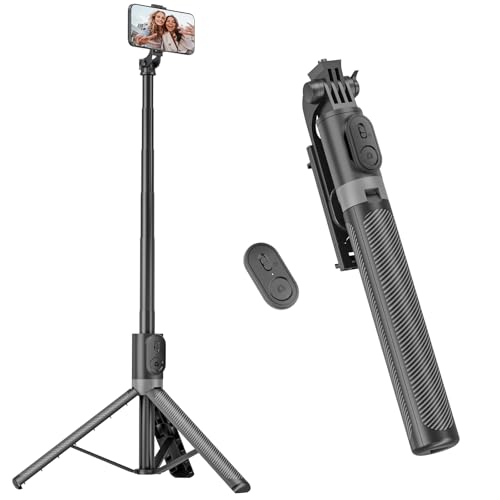
RISEOFLE 71” Phone Tripod & Selfie Stick, Portable All in One Extendable Cell Phone Tripod Stand, with Wireless Remote Control for iPhone/Samsung/Android/Camera
As an Amazon Associate we earn from qualifying purchases. Product prices and availability are accurate as of the date/time indicated.
Prices shown are approximate and for reference only. Prices change often, so please check the current price on Amazon before you buy.
Heights, mounts, and remotes summarize manufacturers’ published information for current versions; verify phone size and camera weight compatibility. Ratings are editorial, weighing stability in both modes where applicable, packed size, clamp and remote quality, build, and value.
The Six Travel Photo Tools Reviewed
1. ATUMTEK 51-Inch Hybrid: Best Overall
ATUMTEK’s hybrid leads because it takes both of its jobs seriously at a price that makes it the trip’s easiest purchase: an extension that reaches the composed self-portrait’s height and the group shot’s angle, legs that splay from its handle into a tripod stable enough for the night mode’s long seconds on ordinary ground, a clamp with real grip, and a remote that docks in the handle where remotes survive. Its last segment flexes like every stick’s, its legs want level ground like every hybrid’s, and within those physics it is the most complete answer to the keyword’s question this table offers, the one tool that covers the solo traveler’s whole day. For the phone-only traveler packing light, it is the recommendation this guide defends first and most often.
2. UBeesize 61-Inch Class: Best Tall Hybrid Value
UBeesize’s taller hybrids answer the hybrid’s commonest complaint, the tripod that composes from the waist, with height in the class that frames a standing portrait properly, at street prices that regularly undercut the leader’s. Its stability at full extension is the tall hybrid’s physics, respected by using the last segment sparingly outdoors, and its accessory bundles, mounts and lights in some kits, should be bought for the tripod and not for the garnish. For the taller traveler, the group photographer, and the creator filming at standing height, it is the value row with a genuine argument, and its rating reflects a tool whose headline number, unusually, is the one its owners actually use.
3. JOBY GorillaPod: Best for Uneven Places
The GorillaPod remains the answer to the tripod’s oldest travel problem, the world refusing to provide a flat surface: its ball-jointed legs wrap a railing, grip a branch, and stand splayed on rocks and ruins where no conventional leg set finds three points of agreement, in a package that rides in a jacket pocket’s neighborhood. Its height is its limit, a foot’s class rather than a portrait’s, so its compositions are the low angle, the tabletop, and the wrapped vantage, which its owners come to treat as a style rather than a compromise. Its joints stiffen and loosen across years of service in the known pattern, and its phone kits pair it with clamps in its maker’s ecosystem. For the traveler whose terrain is irregular and whose bag is small, it is not the alternative to the hybrid but its necessary companion, and many kits in this guide’s audience will end up owning both.
4. Fugetek Professional Stick: Best Pure Selfie Stick
Fugetek’s stick represents the pure form done durably: a long reach for the big group and the wide landmark, a build that has survived years as the category’s workhorse recommendation, and a remote in the kit, without tripod pretensions to grade. Its length is its wobble’s lever, used wisely at partial extension, and its packed size is the stick class’s. It earns its row for the traveler who knows their album, all reach and angle and spontaneity, no night exposures asking for a foundation, and who would rather have the stick perfected than the hybrid’s compromise. In a table of dissolving categories, it is the reminder that a single job done excellently is still a product philosophy, and for some itineraries, the correct one.
5. Peak Design Travel Tripod: Best True Tripod
Peak Design’s travel tripod is the spectrum’s far end and its price’s justification is architectural: legs that fold against the center column into a diameter no rival matches, so a real tripod, full height, real head, camera-weight capacity, rides in a bag’s water-bottle space, with a phone mount concealed in its design for the hybrid shooter. Its aluminum class carries the value argument against its carbon sibling, its setup is the fastest of the true tripods, and its night and long-exposure work is in another discipline from every hybrid above it, as its price announces. For the traveler who shoots a mirrorless camera alongside the phone, whose trip’s purpose includes the photographs, it is the one purchase here that is an investment rather than an accessory, and its rating leads the table on the strength of doing the tripod’s job without the tripod’s traditional bulk.
6. Manfrotto PIXI: Best Tabletop Mini
The PIXI is the smallest honest tripod in the table: a tabletop foundation with a push-button ball head of genuine quality, from a maker whose tripods hold the world’s cameras, sized for the cafe table, the hostel desk, the video call, and the low vantage, and built to a standard the no-name minis gesture at. It holds phones in a clamp and light cameras on its screw, it sets up in seconds, and it disappears into any bag’s corner. Its height is a table’s, which defines its kingdom precisely, and within it, it is the connoisseur’s row, the tool bought once and carried for a decade of trips whose big photographs are taken by its larger cousins in this table.
Buying Guide: How to Choose Between a Selfie Stick and a Tripod for Travel
Step One: Audit Your Album Before Your Bag
Open last trip’s photographs, or the honest imagination of this trip’s, and sort them by the tool they needed: the solo shots that do not exist because no one was asked, the group photographs missing their photographer, the landmarks cropped by an arm’s length, those are the stick’s unclaimed work; the night scenes blurred or noised, the sunsets that flattened, the self-portraits never composed, those are the tripod’s. Whichever pile is larger chooses the spectrum’s end, and the traveler whose piles are equal buys the hybrid and accepts its physics at both jobs with the grace of someone carrying one tool instead of two. Add the trip’s constraints to the audit: the venues’ rules on sticks and tripods, checked per site as the etiquette section insists; the bag’s true remaining volume, measured rather than assumed; and the shooting device, phone-only kits living happily in this table’s hybrid rows while a mirrorless camera in the bag pulls the purchase toward the true tripod as surely as gravity.
Step Two: Test Stability, Clamp, and Remote Like a Traveler
Perform the doorstep tests within the return window, loaded with your phone in its case, since the case’s weight and width are the clamp’s real specification. For the tripod mode: legs spread on the hardest floor you own, the phone mounted at working height, one firm tap, and the wobble’s settling counted, a second or two being a pass and a long shiver being a return. For the stick mode: extension to your real working length, not the maximum, the phone raised and panned slowly, the flex and the clamp’s creak judged as the video they would produce. Work the remote until its pairing is boring, confirm its range across a plaza’s width rather than a room’s, and find its dock or its storage, because the remote’s loss rate in this category is a scandal the docked designs exist to end. Check the clamp against your next phone as well as your current one where sizes allow, since the tool will outlive the phone, and a clamp at its limit today is a tool retired early tomorrow.
Step Three: Pack It, Protect the Phone, and Learn the Venue Rules
Integrate the tool into the trip’s systems before departure: its home in the bag decided, daypack side pocket for the hybrid, the tripod riding where its length lies, so it is present for the unplanned photograph rather than archived at the hotel; the phone’s own protection reviewed, a case whose grip the clamp was tested with, a wrist lanyard for the stick’s work over water and railings and crowds, since the stick raises the phone over exactly the surfaces a fall would end it on; and the battery and Bluetooth habits set, the remote’s cell fresh, the pairing tested after the phone’s updates rather than at the viewpoint. Learn each destination’s rules as part of the itinerary’s research, the museums, sites, and stadiums on the list checked for their stick and tripod policies alongside their hours, because the prepared traveler photographs inside the rules and the unprepared one argues at gates. Then travel, and let the album’s next audit, the piles reversed, the missing photographs present, be the review that matters, written in pictures rather than in stars.
Frequently Asked Questions About Selfie Sticks vs Tripods for Travel
Is a selfie stick or a tripod better for a solo traveler?
The hybrid stick-tripod is the solo traveler’s honest answer, which is why it leads this guide’s table: the stick mode solves the solo problem in its spontaneous form, the photograph taken now, at the railing, in the market, with the traveler in it; and the tripod mode solves it in its composed form, the camera placed and framed, the remote pressed from inside the scene, the portrait made like a photograph rather than a proof of presence. The pure stick leaves the night and the composed portrait unclaimed; the pure tripod is absent from the hundred spontaneous moments, left behind for its size or set up too slowly. The solo traveler should therefore buy the hybrid whose both modes pass this guide’s tests, pack it where it lives within reach, and learn the remote’s walk-in, a few steps, a natural stance, the shutter pressed from a pocketed hand, until the technique disappears and only the photographs, the traveler present in their own journey at last, remain as evidence.
Are selfie sticks and tripods allowed at tourist attractions?
Often restricted, increasingly, and always worth checking per venue, because the rules are local, change over time, and are enforced at gates by people unmoved by a product’s marketing. Selfie sticks are prohibited at many museums, galleries, historic interiors, theme parks, and stadiums, on grounds of artwork safety, crowd safety, and sightlines; tripods are commonly restricted in interiors, at crowded monuments, and anywhere their legs endanger other visitors, with permits sometimes required for anything resembling professional equipment. The practical doctrine is threefold: research each major venue’s photography policy with its hours, as Step Three prescribes; carry the tool so it can be checked, bagged, or left without ruining the visit, since a hybrid in a daypack raises fewer questions than a tripod in hand; and accept a refusal with the traveler’s grace, photographing with the phone alone and remembering that the rule exists because a thousand sticks a day is a different proposition from yours. The prepared traveler loses no photographs to surprise, which is the only kind of loss this category cannot blame on physics.
Can a selfie stick tripod hold a real camera?
The hybrids in this table are phone tools, and their clamps, leg locks, and stems are rated, where rated at all, for a phone’s weight and leverage; a compact camera on an adapter may sit within some models’ capacity for a static shot, but the combination should be treated as an improvisation, tested over a bed, and never extended on a stick over pavement, since a camera’s weight at a stick’s leverage multiplies beyond anything the clamp was promised. Mirrorless and larger cameras belong on the true tripod row, whose heads, screws, and capacities are published for exactly that duty, with the phone joining it through its mount as the second device. The boundary is worth respecting in both directions: the phone on the big tripod is a delight, the camera on the phone stick is a claim waiting for its adjuster, and the traveler who carries both devices should buy for the heavier one’s safety and let the lighter one enjoy the overbuilt ride, which is this guide’s general rule for every mount, clamp, and strap it has ever graded.
What height selfie stick tripod do I need for travel?
For the tripod mode’s composed portrait, height to roughly the traveler’s chest or eye level at the working distance is the honest target, which in the hybrid class means the fifty-to-sixty-inch rows of this table, since a tripod that frames from the waist flatters no one and crops the landmark besides. For the stick mode, the needed reach is shorter than the maximum printed, the flattering group and solo framing living at two-thirds extension where the wobble is tame, so a stick’s headline length should be discounted by a third in the planning and the surplus treated as the occasional wide group’s reserve. Tabletop and mini tripods answer a different geometry entirely, their surface supplying the height, and the GorillaPod’s wrapped vantage ignores height altogether. Measure the need against your own photographs, the portrait’s distance, the group’s width, rather than against the listing’s largest number, because in this category the maximum specification is the one used least and flexed most, and the working middle, stable and sufficient, is where the album is actually made.
Related guides
- Best Laptop Dock for Dual Monitors in 2026: Thunderbolt Docks That Drive Two 4K Displays and Charge With One Cable
- Best Cheap Mechanical Keyboard for Students: 6 Best Cheap Mechanical Keyboard for Students Picks in 2026
- Best Monitor for Photo Editing Accuracy in 2026: EIZO, BenQ, ASUS ProArt, and Dell Compared for a Calibration Kept on a Calendar, a Gamut Read in Documents, and a Room Whose Light Is Part of the System
- Best Action Camera for Biking in 2026: How to Pick an Action Camera That Captures Smooth, Clear Video on Your Bike Ride
More from Amazon
Programs that pair well with the guide above. Offers and eligibility are set by Amazon and may change.
Free shipping on eligible items, Prime Video and more. Eligible new members can start with a free trial.
Start a Prime free trialAd-free music streaming. Eligible new subscribers can start with a free trial.
Try Music Unlimited freeA Prime membership for ages 18-24 with a trial period. Eligibility is set by Amazon.
See Prime for Young AdultsAudiobooks and podcasts to listen to on the go. Eligible new members can start with a free trial.
Try Audible freeAs an Amazon Associate we earn from qualifying purchases.

Write Your Review
No reviews yet. Be the first to share your experience!