
What's inside
- Best Speaker for Garage Workshops: Quick Comparison Table
- Why a Garage Workshop Needs a Different Speaker
- Best Speaker for Garage Workshops Reviewed
- Buying Guide: How to Choose the Best Speaker for Garage Workshops
- How to Use a Speaker for Garage Workshops Safely
- Which Best Speaker for Garage Workshops Should You Buy?
- Frequently Asked Questions About the Best Speaker for Garage Workshops
As an Amazon Associate I earn from qualifying purchases. This post may contain affiliate links at no extra cost to you.
The best speaker for garage workshops is not a small bedroom speaker that disappears under the sound of a table saw, and it is not a large home stereo that cannot handle dust, a dropped wrench, or a splash from a wet floor. It is a loud, durable speaker with a battery that lasts through a long project, a body that can take a knock, and a sound that stays clear when a compressor kicks on, a grinder sparks, or a garage door opens. A workshop speaker has to work in a space that is often cold in winter, hot in summer, dusty all year, and full of hard surfaces that bounce sound around.
For most garage workshops, a portable Bluetooth speaker with 20 to 40 watts of output is a good starting point. That is enough to fill a single-car or double-car garage with music or a podcast, without needing a wired receiver and separate speakers. A jobsite speaker that runs on a tool battery can be even more useful, because you can swap a battery you already own and keep working without looking for an outlet. A speaker with an IP65 or IP67 rating will handle dust and light rain better than a speaker with no rating, and a speaker with a handle, a roll cage, or rubber bumpers will survive a fall from a workbench better than a smooth plastic speaker.
At techymoon.com, we focus on tech gadgets. For this guide to the best speaker for garage workshops in 2026, we compared current portable and jobsite speakers that are widely sold, designed for outdoor or jobsite use, and suitable for a home garage, a workshop, or a shed. We looked at output power, battery life, water and dust resistance, Bluetooth range, size, weight, and price. Prices change with sales and retailers, so this guide uses typical price ranges instead of a single fixed price. Power, battery, and IP figures are manufacturer listings, and real volume and battery life depend on how loud you play, what you play, and the temperature in your garage.
Safety note: keep a speaker away from sawdust piles, flammable liquids, and water on the floor. Do not place a speaker where it can fall onto a tool, a car, or a person, and keep the volume low enough that you can hear a smoke alarm, a phone, or someone calling from inside the house. If you wear hearing protection, check that you can still hear important sounds, or use a speaker at a lower volume with earbuds under earmuffs only if that is safe for your work.
Our Top Picks
Best Speaker for Garage Workshops: Quick Comparison Table
The table below compares six speakers for garage workshops. Output is the manufacturer-listed power, where given. Battery is the typical play time, where given. Rating is the dust and water rating, where given. Bluetooth is the Bluetooth version, where given. Weight is the weight, where given. Best for is a note on what the speaker is best for, such as a tool battery system or a portable speaker, where given. Price is the typical range, and rating is our editorial score based on loudness, clarity, durability, battery life, and value for a garage workshop.
| Speaker for Garage Workshops | Output Power | Battery Life | Dust and Water Rating | Bluetooth | Weight | Best For | Typical Price Range | Our Rating |
|---|---|---|---|---|---|---|---|---|
| DEWALT 20V MAX Bluetooth Speaker DCR010 | About 20W | Up to 12 hours on 5.0Ah battery | IP54 | Bluetooth 4.2 | About 3.5 lb | Best overall, DEWALT users | $70 – $100 | 4.9 / 5 |
| Milwaukee M18 Jobsite Speaker 2891-20 | About 20W | Up to 12 hours on 5.0Ah battery | IP64 | Bluetooth 4.2 | About 3.8 lb | Best for Milwaukee users | $80 – $110 | 4.8 / 5 |
| JBL Charge 6 | About 45W | Up to 24 hours | IP68 | Bluetooth 5.4 | About 2.1 lb | Best portable, loud and waterproof | $150 – $200 | 4.8 / 5 |
| Anker Soundcore Boom 2 | About 60W | Up to 24 hours | IPX7 | Bluetooth 5.3 | About 3.7 lb | Best for Anker, loud bass | $100 – $140 | 4.8 / 5 |
| Ryobi 18V ONE+ Bluetooth Speaker P746 | About 15W | Up to 10 hours on 4.0Ah battery | IP54 | Bluetooth 4.2 | About 3.0 lb | Best budget, Ryobi users | $50 – $80 | 4.6 / 5 |
| Ultimate Ears Wonderboom 4 | About 20W | Up to 14 hours | IP67 | Bluetooth 5.3 | About 0.9 lb | Best small, portable workshop | $80 – $110 | 4.7 / 5 |

ANCOON Speakers Bluetooth Wireless: 80W(Peak) Loud Speaker with Bass | 20H, Rugged, IPX6 Waterproof, Large Jobsite Speakers for Work, Outdoor, Workshop, Garage - Portable Handle with TWS (Black)
As an Amazon Associate we earn from qualifying purchases. Product prices and availability are accurate as of the date/time indicated.

Qozybuds Bluetooth 6.0 Speaker, 80W(Peak) Loud Speaker with Bass, 30H Working Time, IPX6 Waterproof Large Jobsite Speakers with TWS, RGB Lights for Work, Outdoor, Workshop, Garage (Red)

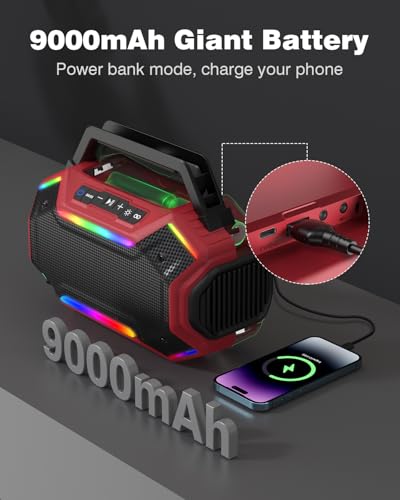


As an Amazon Associate we earn from qualifying purchases. Product prices and availability are accurate as of the date/time indicated.

Upgrade Jobsite Emergency Radio Bluetooth 30W Jobsite Speaker,IPX66 Waterproof Outdoor Radio,Portable with LED Light,Anti‑Collision FM Clock Radio for Construction Site Camping,Workshop, Garage
As an Amazon Associate we earn from qualifying purchases. Product prices and availability are accurate as of the date/time indicated.
Note: Battery life figures are manufacturer listings at moderate volume, and a speaker that lists 24 hours may last 10 to 14 hours at high volume in a garage. Tool-battery speakers are often sold as a bare tool, so the battery and charger are not always included. Always check whether the price is for the speaker only or for a kit, check the IP rating, and confirm the current price with the retailer.
Why a Garage Workshop Needs a Different Speaker
A garage workshop needs a different speaker for three reasons: noise, dust, and power. Noise matters because a workshop is louder than a living room. A table saw, a router, a vacuum, and an air compressor can all reach 80 to 90 dBA, and a small speaker at 10 watts will be hard to hear over them. A speaker with 20 to 60 watts, a clear midrange, and a strong bass can cut through that noise better than a speaker that is made for a quiet bedroom.
Dust matters because a garage workshop creates sawdust, metal shavings, and concrete dust that can get into a speaker grille, a charging port, and a button. A speaker with an IP54, IP64, IP67, or IP68 rating is sealed against dust and water better than a speaker with no rating. A speaker with a rubber cover over its ports, a sealed battery compartment, and a washable grille will last longer in a workshop than a speaker with open ports and a fabric cover that traps dust.
Power matters because a garage may have only one or two outlets, and they may already be used by a charger, a saw, and a light. A battery speaker that runs on a tool battery you already own, such as a DEWALT 20V MAX, Milwaukee M18, or Ryobi 18V ONE+ battery, lets you move the speaker around the garage without a cord. A built-in battery speaker, such as a JBL Charge 6 or Anker Soundcore Boom 2, can also work, but you will need to charge it from a USB-C charger when it runs low.
Best Speaker for Garage Workshops Reviewed
1. DEWALT 20V MAX Bluetooth Speaker DCR010 – Best Speaker for Garage Workshops Overall
The DEWALT 20V MAX Bluetooth Speaker DCR010 is our top pick because it is made for a jobsite, it runs on a DEWALT 20V MAX battery you may already own, and it is loud enough for a garage. It has about 20 watts of output, a battery life of up to 12 hours on a 5.0Ah battery as listed by DEWALT, an IP54 rating for dust and water, Bluetooth 4.2, and a weight of about 3.5 pounds. It has a roll cage, a handle, and rubber feet, so it can sit on a workbench or hang from a hook.
DEWALT designs the DCR010 with a focus on durability. The roll cage protects the speaker from a fall, the controls are large enough to use with gloves, and the speaker has a USB port for charging a phone. It also has an auxiliary input, so you can plug in a phone or a radio if Bluetooth is not working. The sound is clear in the midrange, which helps for podcasts and voice, and the bass is enough for music in a garage, though it is not as deep as a larger party speaker.
The main limitation is that the battery and charger are not always included. The DCR010 is often sold as a bare tool, so you need a DEWALT 20V MAX battery to use it without a cord, or you can plug it into a wall outlet with an adapter. Typical price is $70 to $100 for the speaker only. Choose the DCR010 if you already use DEWALT 20V MAX tools, you want a jobsite speaker, and you want a speaker that can take a knock in a garage.
2. Milwaukee M18 Jobsite Speaker 2891-20 – Best Speaker for Garage Workshops for Milwaukee Users
The Milwaukee M18 Jobsite Speaker 2891-20 is a 20-watt jobsite speaker that runs on a Milwaukee M18 battery. It has a battery life of up to 12 hours on a 5.0Ah battery as listed by Milwaukee, an IP64 rating for dust and water, Bluetooth 4.2, and a weight of about 3.8 pounds. It has a handle, a roll cage, and a design that can sit on a workbench, hang from a hook, or stand on a floor.
Milwaukee designs the 2891-20 with a focus on sound quality for its size. It has a passive radiator that helps with bass, and a clear tweeter for voice. The controls are simple, with a large volume knob and a Bluetooth pairing button that is easy to find with gloves. It also has a USB port for charging a phone, and an auxiliary input for a wired connection.
The main limitation is price and battery. At a typical $80 to $110 for the speaker only, it costs more than the Ryobi speaker, and you need an M18 battery to use it without a cord. Choose the 2891-20 if you already use Milwaukee M18 tools, you want a jobsite speaker with an IP64 rating, and you want a speaker that is built for a workshop.
3. JBL Charge 6 – Best Speaker for Garage Workshops for Portable Use
The JBL Charge 6 is a portable Bluetooth speaker with about 45 watts of output, a battery life of up to 24 hours as listed by JBL, an IP68 rating for dust and water, Bluetooth 5.4, and a weight of about 2.1 pounds. It has a handle, a USB-C port for charging, and a USB-A port that can charge a phone from its built-in battery, which acts as a power bank.
JBL designs the Charge 6 with a focus on loud, clear sound in a small body. It has a woofer, a tweeter, and two passive radiators, which give it more bass than a small speaker. The IP68 rating means it can handle dust, a splash, and even being dropped in water, though you should not use it as a waterproof speaker in a workshop sink. It is easy to carry from a garage to a garden, a car, or a jobsite, and it pairs quickly with a phone.
The main limitation is that it is not a jobsite speaker, so it does not have a roll cage or a tool-battery option. It is also more expensive than a DEWALT or Ryobi speaker, at a typical $150 to $200. Choose the Charge 6 if you want a portable speaker that is loud, waterproof, and easy to carry, and you do not need a tool-battery system.
4. Anker Soundcore Boom 2 – Best Speaker for Garage Workshops for Loud Bass
The Anker Soundcore Boom 2 is a portable Bluetooth speaker with about 60 watts of output, a battery life of up to 24 hours as listed by Anker, an IPX7 rating for water, Bluetooth 5.3, and a weight of about 3.7 pounds. It has a handle, a USB-C port, and a design that can sit on a workbench or on the floor. It also has a BassUp mode that boosts low frequencies for music.
Anker designs the Boom 2 with a focus on loudness. At 60 watts, it is louder than the JBL Charge 6 and the DEWALT DCR010, and it can fill a double-car garage with music. The sound is clear at high volume, with less distortion than many budget speakers, and the battery lasts through a long project at moderate volume. It also has a built-in handle that makes it easy to carry, and a rubber base that keeps it from sliding on a workbench.
The main limitation is size and dust rating. At 3.7 pounds, it is heavier than the JBL Charge 6, and its IPX7 rating covers water but not dust as clearly as an IP67 or IP68 rating. Typical price is $100 to $140. Choose the Boom 2 if you want a loud speaker with strong bass, you want a long battery life, and you want a portable speaker that is cheaper than a JBL Charge 6.
5. Ryobi 18V ONE+ Bluetooth Speaker P746 – Best Budget Speaker for Garage Workshops
The Ryobi 18V ONE+ Bluetooth Speaker P746 is a budget jobsite speaker that runs on a Ryobi 18V ONE+ battery. It has about 15 watts of output, a battery life of up to 10 hours on a 4.0Ah battery as listed by Ryobi, an IP54 rating for dust and water, Bluetooth 4.2, and a weight of about 3.0 pounds. It has a handle, a roll cage, and a design that is made for a garage or a jobsite.
Ryobi designs the P746 with a focus on value. It is often sold as a bare tool for $50 to $80, which is cheaper than a DEWALT or Milwaukee speaker, and it uses the same 18V ONE+ battery that many home users already own for a drill, a saw, or a vacuum. The sound is clear for podcasts and music at moderate volume, though it is not as loud as a 60-watt speaker. It also has a USB port for charging a phone.
The main limitation is output. At about 15 watts, it is quieter than the DEWALT DCR010 and the Milwaukee 2891-20, so it may be hard to hear over a loud saw or compressor. Choose the P746 if you already use Ryobi 18V ONE+ tools, you want the lowest price for a jobsite speaker, and you mainly listen at moderate volume.
6. Ultimate Ears Wonderboom 4 – Best Small Speaker for Garage Workshops
The Ultimate Ears Wonderboom 4 is a small portable Bluetooth speaker with about 20 watts of output, a battery life of up to 14 hours as listed by Ultimate Ears, an IP67 rating for dust and water, Bluetooth 5.3, and a weight of about 0.9 pounds. It is small enough to fit in a pocket, hang from a hook, or sit on a shelf, and it has a 360-degree sound design that fills a small garage evenly.
Ultimate Ears designs the Wonderboom 4 with a focus on portability and durability. It can float in water, survive a drop, and play in any direction, so you do not need to point it at yourself. The sound is clear for its size, with a good midrange for podcasts, though the bass is limited by its small size. It also has a loop for hanging from a nail or a hook, which is useful in a garage where bench space is limited.
The main limitation is volume. At 20 watts in a small body, it is not as loud as the Anker Boom 2 or JBL Charge 6, so it is best for a single-car garage or a small workshop, not for a large double-car garage with loud tools. Typical price is $80 to $110. Choose the Wonderboom 4 if you want a small, light speaker, you want to hang it from a hook, and you want a speaker that is easy to carry around a garage.
Buying Guide: How to Choose the Best Speaker for Garage Workshops
Before you buy, think about your garage size, what tools you use, whether you already own a tool battery system, and how much you want to spend. A speaker that is perfect for a small single-car garage may be too quiet for a large double-car garage, and a speaker that is perfect for a DEWALT user may not be the best choice for a Ryobi user. The six points below cover the decisions that matter most for a garage workshop speaker.
1. Loudness: 15W vs 20W vs 60W, and Cutting Through Tool Noise
Loudness is the first decision. A 15-watt speaker, such as the Ryobi P746, can be heard in a quiet garage, but it may be hard to hear over a saw. A 20-watt speaker, such as the DEWALT DCR010 or Milwaukee 2891-20, is louder and clearer for most garages. A 45 to 60-watt speaker, such as the JBL Charge 6 or Anker Boom 2, is loud enough for a large garage and for music with bass.
Choose a 20-watt jobsite speaker if you use power tools, you want a speaker that can cut through noise, and you already own a tool battery. Choose a 45 to 60-watt portable speaker if you want the loudest sound, you want strong bass, and you do not need a tool battery. Do not buy a speaker based on watts alone, because a well-designed 20-watt speaker can sound clearer than a poorly designed 40-watt speaker. Listen to a demo if you can, or check reviews that test volume at a distance.
2. Battery: Tool Battery vs Built-In Battery, and a Long Project
Battery is the second decision. A tool-battery speaker, such as a DEWALT, Milwaukee, or Ryobi model, runs on a battery you can swap in seconds, so you can keep working without waiting for a charge. A built-in battery speaker, such as a JBL or Anker model, has a battery that lasts 14 to 24 hours as listed, but you need to plug it in to charge when it runs low, which can take two to three hours.
Choose a tool-battery speaker if you already own that brand’s batteries, you work for long hours, and you want to swap a battery quickly. Choose a built-in battery speaker if you do not own a tool battery system, you want a speaker you can also use outside the garage, and you can charge it overnight. Check whether the tool-battery speaker includes a battery, because many are sold as a bare tool, and a battery can add $50 to $100 to the total cost.
3. Durability: IP Rating, Roll Cage, and Dust
Durability is the third decision. An IP rating tells you how well a speaker handles dust and water. IP54 means it is protected against dust and splashes, IP64 means it is dust-tight and protected against splashes, IP67 means it is dust-tight and can be submerged in shallow water for a short time, and IP68 means it is dust-tight and can be submerged deeper. A roll cage, rubber bumpers, and a sealed port cover also help a speaker survive a fall and dust.
Choose a speaker with at least IP54 if you work in a dusty garage, and IP64 or higher if you work near water or in a humid garage. Choose a jobsite speaker with a roll cage if you are likely to knock it off a bench, and a portable speaker with rubber feet if you want it to stay put on a workbench. Clean the grille with a soft brush or compressed air, and do not use a high-pressure hose to clean a speaker, even if it has an IP rating.
4. Sound Quality: Clear Voice, Bass, and 360-Degree Sound
Sound quality is the fourth decision. A workshop speaker should have a clear midrange for podcasts and voice, because many people listen to talk radio, audiobooks, or podcasts while they work. Bass matters for music, but too much bass can make voice sound muddy. A speaker with a separate tweeter and woofer, such as the JBL Charge 6, will sound clearer than a speaker with a single driver.
Choose a speaker with a clear midrange if you listen to podcasts, and a speaker with a BassUp or bass boost mode if you listen to music. A 360-degree speaker, such as the Ultimate Ears Wonderboom 4, can fill a small garage evenly, while a front-facing speaker, such as the DEWALT DCR010, sounds best when you are in front of it. Test the speaker with a podcast and a song you know well, so you can hear whether voice is clear and bass is balanced.
5. Connectivity: Bluetooth, Auxiliary Input, and Pairing
Connectivity is the fifth decision. Bluetooth is the most common way to connect a phone to a workshop speaker, and most speakers in this guide use Bluetooth 4.2, 5.3, or 5.4. Bluetooth 5.3 and 5.4 usually have a longer range and a more stable connection than Bluetooth 4.2, which matters in a garage with concrete walls and metal tools that can interfere with a signal.
Choose a speaker with Bluetooth 5.3 or higher if you want a stable connection and a longer range, and a speaker with an auxiliary input if you want a wired backup. Check whether the speaker can pair with a second speaker for stereo sound, because some JBL and Ultimate Ears models can pair together, which is useful in a large garage. Keep your phone within 30 feet of the speaker for the best connection, and avoid placing the speaker behind a large metal tool cabinet, which can block Bluetooth.
6. Price, Total Cost, and Choosing a Speaker on a Budget
Price ranges in this guide run from about $50 to $200 for a speaker for garage workshops, depending on brand, power, and battery type. A budget speaker at $50 to $80, such as the Ryobi P746, is enough for a small garage and a Ryobi user. A mid-price speaker at $70 to $110, such as the DEWALT DCR010, Milwaukee 2891-20, or Ultimate Ears Wonderboom 4, offers a jobsite build or a waterproof design. A premium speaker at $100 to $200, such as the Anker Boom 2 or JBL Charge 6, offers louder sound and a longer battery life.
Consider total cost as well as price. A tool-battery speaker that costs $70 and needs a battery for $60 may cost $130 in total if you do not already own a battery, while a built-in battery speaker that costs $150 may cost $150 in total, with no extra battery needed. Budget for a speaker, and if you need it, a battery, a charger, or a USB-C cable, not just a speaker. Do not buy the cheapest speaker if it is too quiet for your garage, and do not buy the most expensive speaker if you only listen at low volume in a small garage. A speaker with at least 20 watts, an IP54 rating or higher, and a battery that lasts through your project will help you enjoy your garage more than a speaker that is cheap but quiet, or expensive but fragile.
How to Use a Speaker for Garage Workshops Safely
Using a speaker for garage workshops safely starts with placement. Put the speaker on a stable surface, away from the edge of a workbench, away from water on the floor, and away from sawdust piles. Do not place a speaker on top of a tool that vibrates, because it can fall, and do not place it where a car door can hit it when you open the car in the garage.
Keep the volume at a level where you can still hear a smoke alarm, a phone, or someone calling you. If you use hearing protection, do not turn the volume up so loud that it damages your hearing through the protection. Clean the speaker regularly with a dry cloth or a soft brush, and do not use a wet cloth on a speaker that is not rated for water. Store the speaker in a dry place when you are not using it, and charge a built-in battery speaker before you store it for a long time, so the battery does not drain completely.
Which Best Speaker for Garage Workshops Should You Buy?
If you want the best speaker for garage workshops, buy the DEWALT 20V MAX Bluetooth Speaker DCR010. It costs $70 to $100 for the speaker only, it offers about 20 watts, an IP54 rating, and a roll cage, which is the best balance for most DEWALT users in a garage.
If you want a Milwaukee speaker, buy the Milwaukee M18 Jobsite Speaker 2891-20. If you want a portable speaker that is loud and waterproof, buy the JBL Charge 6. If you want loud bass at a lower price, buy the Anker Soundcore Boom 2. If you want the lowest price for a jobsite speaker, buy the Ryobi 18V ONE+ Bluetooth Speaker P746. If you want a small, light speaker you can hang from a hook, buy the Ultimate Ears Wonderboom 4.
All six speakers in this guide are currently sold, designed for outdoor or jobsite use, and suitable for a home garage, a workshop, or a shed. Pick the one that matches your garage size, your tool battery system, how loud you need it, and your budget, and always keep the volume low enough to hear important sounds, keep the speaker away from water and dust piles, and store it in a dry place when you are not using it.
Disclosure: techymoon.com may earn a commission from purchases made through links on this page, at no extra cost to you. Prices listed are typical ranges and can vary by retailer and sale. Power, battery, and IP figures are manufacturer claims and can vary by model and conditions. Always check whether a tool-battery speaker includes a battery, and follow the manufacturer’s safety instructions for charging and use.
Frequently Asked Questions About the Best Speaker for Garage Workshops
What is the best speaker for garage workshops?
What is the best speaker for garage workshops? In most cases, the DEWALT 20V MAX Bluetooth Speaker DCR010 is best overall, because it costs $70 to $100 for the speaker only, it offers about 20 watts, an IP54 rating, and a roll cage, and it runs on a DEWALT battery you may already own. The Milwaukee M18 Jobsite Speaker is best if you use Milwaukee tools, while the JBL Charge 6 is best if you want a portable speaker, and the Anker Boom 2 is best if you want loud bass.
Is a jobsite speaker or a portable Bluetooth speaker better for a garage?
Is a jobsite speaker or a portable Bluetooth speaker better for a garage? In most cases, a jobsite speaker is better if you already own that brand’s tool batteries, you work in a dusty garage, and you want a speaker that can take a knock. A portable Bluetooth speaker is better if you do not own a tool battery system, you want a speaker you can also use outside the garage, and you want a longer built-in battery life. Choose a jobsite speaker for durability and battery swapping, and a portable speaker for versatility and sound quality.
How loud does a garage workshop speaker need to be?
How loud does a garage workshop speaker need to be? In most cases, a speaker with 20 watts is enough for a single-car garage, while a speaker with 45 to 60 watts is better for a double-car garage or for listening over loud tools. A 15-watt speaker can work at moderate volume, but it may be hard to hear over a table saw or a compressor. Choose at least 20 watts for a workshop, and use a fan curve or volume control to keep the sound clear without distortion at high volume.
Can I leave a Bluetooth speaker in a cold or dusty garage?
Can you leave a Bluetooth speaker in a cold or dusty garage? In most cases, you can leave a speaker with an IP54 rating or higher in a garage, but you should store it in a dry place, away from direct dust and moisture, when you are not using it. Cold can shorten battery life, and dust can clog a grille, so clean the speaker with a soft brush, charge it before storage, and bring it inside in very cold weather if you can. Check the manufacturer’s storage temperature range before you leave a speaker in a garage for a long time.
Related guides
- Best Stool for Standing Desks in 2026: 7 Best Stools for Standing Desks That Let You Sit, Lean, and Stand Without Hurting Your Back
- Mechanical Keyboard vs Membrane Keyboard Feel in 2026: 6 Top Keyboards Compared, Mechanical vs Membrane Keyboards, and Easy Use
- Best Budget Travel Keyboard Case for Travelers in 2026: 7 Cases That Offer Safe Storage, Easy Carrying, and Reliable Use for Travelers
- Best RGB Keyboard for Gaming Setup in 2026: RGB Keyboards for Gaming Setup, PC Gaming, and Desk Setups
More from Amazon
Programs that pair well with the guide above. Offers and eligibility are set by Amazon and may change.
Free shipping on eligible items, Prime Video and more. Eligible new members can start with a free trial.
Start a Prime free trialAd-free music streaming. Eligible new subscribers can start with a free trial.
Try Music Unlimited freeA Prime membership for ages 18-24 with a trial period. Eligibility is set by Amazon.
See Prime for Young AdultsAudiobooks and podcasts to listen to on the go. Eligible new members can start with a free trial.
Try Audible freeAs an Amazon Associate we earn from qualifying purchases.

Write Your Review
No reviews yet. Be the first to share your experience!