
What's inside
- How to Choose Handheld Console for Travel: The Four Tests
- Quick Comparison: Handheld Consoles for Travel Compared
- How to Choose Handheld Console for Travel: The Six Reviewed
- Buying Guide: How to Choose a Handheld Console for Travel, Step by Step
- How We Selected These Handheld Consoles for Travel
- Frequently Asked Questions About Choosing a Handheld Console for Travel
As an Amazon Associate I earn from qualifying purchases. This post may contain affiliate links at no extra cost to you.
How to choose handheld console for travel is a question most buyers answer backwards: they compare processors and screens in a showroom, then discover at 30,000 feet that the number that mattered was battery life, and at the hostel that the library that mattered was the one they already owned. Travel is a specific discipline for a handheld console. It must survive a long-haul sector without a socket, entertain offline in a metal tube and a rural guesthouse, pack into a carry-on already full of everything else, charge from the same power bank as your phone, and be replaceable — emotionally and financially — if a trip goes wrong. This guide builds the choice in the traveller’s order: the games you own, the hours you travel, the bag you carry, and only then the hardware, comparing the real, currently sold handhelds against those tests.
Start with the library, because it is the decision you cannot upgrade later. If your games live on Nintendo’s platform — the Marios, Zeldas, and Pokémons of this world — only a Nintendo console plays them, and the choice narrows to which Nintendo. If your library is a decade of Steam purchases, a PC handheld turns that sunk cost into a travel catalogue of hundreds of games at no further expense, which is the single strongest argument in this entire category. If you own neither, choose by the travelling you’ll actually do: short hops and family trips favour Nintendo’s simplicity and local multiplayer; long solo journeys favour the PC handheld’s depth, price-per-game, and freedom. Emulation, cloud streaming, and subscription libraries all exist, but each carries its own conditions — streaming above all needs the fast, stable connection that travel most reliably denies you — so build the plan on games that run offline, downloaded, tested, and updated before you leave home.
The practicalities are unglamorous and decisive. Battery figures published by makers are measured under conditions kinder than a bright screen and a demanding game at altitude, so read them as comparisons between models, then plan on a USB-C power bank — carried in the cabin, within the airline’s published limits — as part of the system for any journey longer than the console’s honest endurance. Size and weight compound across a trip: a large, heavy handheld is a joy in a hotel and a calculation in a one-bag itinerary. And a hard case is not an accessory for travel; it is the product’s second half, bought the same day, because a handheld’s screen and sticks face a bag’s worth of hazards every time the bag moves.
Our Top Picks
How to Choose Handheld Console for Travel: The Four Tests
Test One: Your Library and Your Games’ Offline Manners
List the ten games you would actually play on the trip and check, for each, three things: it runs on the console you are considering, it runs fully offline — some titles and launchers require periodic check-ins or constant connections — and it is downloaded and launched once at home, because the first-launch update discovered in airplane mode is a travel story nobody enjoys twice. Nintendo’s ecosystem is the simplest here: cartridges and downloads that simply work, with family-friendly local multiplayer from one machine. The PC handhelds ask a little more administration and repay it with your existing Steam library, broader sales, and genres a console store cannot match. Choose the ecosystem by the list of ten, not by the showroom’s demo reel.
Test Two: Battery Against Your Longest Leg
Take your longest realistic travel day — door to door, delays included — and set the console’s honest endurance against the hours of it you would actually play. Light and older games sip power on every machine here; the newest big titles drink it, and on the powerful PC handhelds can drain a full charge in a small number of hours at full settings. The traveller’s techniques are part of the purchase: brightness discipline, frame-rate caps, per-game power settings on the PC machines, airplane mode, and a power bank sized to the airline’s cabin rules and the console’s charging standard. A console that needs its settings managed is not a worse console; it is a different contract, and this guide states it per model so you sign knowingly.
Test Three: Size, Weight, and the Case in the Bag
Weigh the decision literally. The lightest machines here disappear into a personal item and come out for a forty-minute train ride; the largest need a carry-on’s deliberate corner and come out for the evening. Screen size pulls the other way — text-heavy strategy and RPGs reward the big displays, tired eyes at midnight reward them more — so the honest test is your own itinerary performed at home: pack the bag as for the trip, with the console in its case, and carry it for a day. Travellers forgive weight in a machine they use for four hours a night and resent it in one they use for twenty minutes, which is why this test comes after the library and the battery, not before.
Test Four: The Travelling Life Around the Console
Charging standard first: every serious contender here charges by USB-C, but their appetites differ, and the high-power PC handhelds need a suitably rated charger and bank to charge at full speed or even while playing — check the published requirements and pack one charger that serves console, phone, and laptop if the ratings allow. Docking matters to the hotel-room traveller: Nintendo’s consoles and the PC handhelds can all drive a TV through their docks or a USB-C connection, turning one machine into the room’s entertainment, with a compact controller as the travelling companion. Finally, price the risk: a console is a theft-attractive, droppable object, so a case, a bag it never leaves unattended, and an honest thought about travel insurance are part of choosing, not an afterthought.
Quick Comparison: Handheld Consoles for Travel Compared
| Handheld Console Model | Best For | Key Specs | Typical Price Range | Rating |
|---|---|---|---|---|
| Nintendo Switch 2 | Best handheld console for travel overall | Current Nintendo platform with larger display, Nintendo game library, TV dock support, USB-C charging, published battery estimates by game as listed | $450 – $500 | 4.8 / 5 |
| Valve Steam Deck OLED | Best for Steam library owners | PC handheld with OLED display, Steam library access, published battery range by workload, USB-C charging and dock support as listed | $550 – $650 | 4.7 / 5 |
| Nintendo Switch Lite | Best light and budget traveller | Compact handheld-only Nintendo console, lightest in this table, no TV output, long battery life for its class as published | $200 – $230 | 4.5 / 5 |
| ASUS ROG Ally X | Best Windows power and battery in class | Windows PC handheld with large battery for its class, high performance modes, USB-C charging, published specs as listed | $800 – $900 | 4.6 / 5 |
| Nintendo Switch OLED | Best for families and shared play | OLED display model, detachable controllers for two-player travel play, dock for TV use, established game library as published | $320 – $350 | 4.6 / 5 |
| Lenovo Legion Go | Best big screen | Large high-resolution display, detachable controllers, Windows platform, among the heaviest here as published | $650 – $800 | 4.3 / 5 |

R36MAX Handheld Game Console, 4.0-Inch HD IPS Portable Gaming Console | 64GB Storage, 4000mAh Long Lasting Battery, Ergonomic Mini Game Player for Home & Travel, Black
As an Amazon Associate we earn from qualifying purchases. Product prices and availability are accurate as of the date/time indicated.

RS36MAX Retro Handheld Game Console, Retro Gaming Console, 4.0" IPS Screen | 20+ Game Emulators, Support 64GB TF Storage Card, Portable for Home & Travel, Black


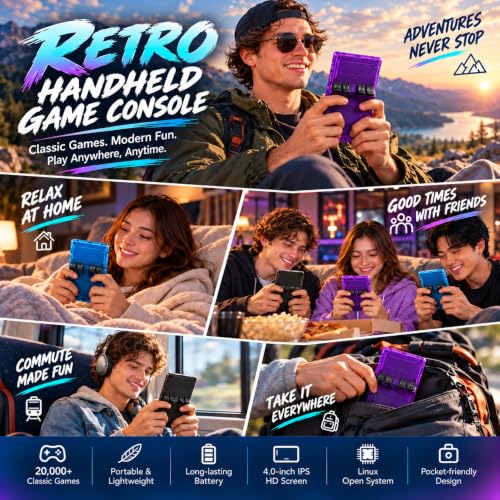

As an Amazon Associate we earn from qualifying purchases. Product prices and availability are accurate as of the date/time indicated.

32 Bit Handheld Games for Kids Preloaded 139 Retro Video Games, Blue | Portable Video Gaming Player with 3.0" IPS Screen Rechargeable Battery,Mini Travel Games Electronic Gifts Toys for Boys Girls
As an Amazon Associate we earn from qualifying purchases. Product prices and availability are accurate as of the date/time indicated.
Ratings are editorial assessments for travel specifically, based on the makers’ published battery, size, weight, and charging specifications, and value at typical prices. Prices are typical retail ranges. Battery life in real travel varies widely with the game, screen brightness, and settings, as this guide explains; the makers’ published figures are best used to compare models against each other, not as promises for a particular title.
How to Choose Handheld Console for Travel: The Six Reviewed
1. Nintendo Switch 2 – Best Overall for Travel
Nintendo’s current console takes the top spot for the traveller without a large existing library, because it passes all four tests with the least administration: a library of exclusives that simply run offline, a form that suits both a flight tray and a hotel dock, detachable-controller multiplayer that turns a delayed train into a family event, and an ecosystem a non-technical travelling companion can operate without a tutorial. Its battery, like every machine here, must be read by the game — plan the power bank for the longest day. For most travellers buying one machine for trips of every kind, this is the default, and defaults earn that status by failing the fewest journeys.
2. Steam Deck OLED – Best for the Steam Library Owner
If your games already live on Steam, the Deck OLED is not merely an option but the arithmetic winner: the library is bought, the catalogue is enormous, and the machine’s OLED screen and refined power management make it the most travel-mannered of the PC handhelds. Its honest costs are size — it is a carry-on commitment in its case — and the PC contract: per-game settings, the occasional launcher friction, and updates to run before departure. Travellers who accept that contract get the deepest, cheapest-per-game travel gaming in this table, and a dock turns it into the hotel room’s computer as well.
3. Nintendo Switch Lite – Best Light and Simple
The Lite is the traveller’s minimalist answer: the smallest, lightest, and cheapest route into Nintendo’s library, with no dock, no detachable controllers, and nothing to lose, break off, or leave in a seat pocket. It suits the solo traveller, the child whose console will be dropped as a lifestyle, and the one-bag packer for whom the bigger machines fail the bag test. Check that your intended games suit handheld-only play — most do, a few lean on features the Lite lacks — and it becomes the console most likely to be in the bag when a journey appears, which is its own category of best.
4. ASUS ROG Ally X – Best Windows Power
The Ally X is the Windows handheld built with travel’s main complaint in mind: its battery is the largest in its performance class, answering the earlier generation’s short endurance, while its power runs the current catalogue at settings the lighter machines cannot attempt. It carries the full Windows contract — updates, launchers, settings, and the occasional desktop detour on a small screen — and repays the technically comfortable traveller with the broadest compatibility in the table, including the subscription and store ecosystems beyond Steam. Buy it for power with endurance, knowingly, and it delivers both.
5. Nintendo Switch OLED – Best for Families
The original Switch in its OLED form remains a superb travel purchase, often at a friendlier price than the newest model: a beautiful screen, the full established library at its deepest and cheapest, and the two-player-from-one-console trick that no PC handheld can imitate at a café table. Families, especially, should run the numbers here before defaulting to the newest machine — two of these, or one shared, can serve a trip better than a single flagship. Its age shows only in the newest games’ performance, which its library’s classics do not ask about.
6. Lenovo Legion Go – Best Big Screen, With a Weight Warning
The Legion Go’s large, high-resolution display is genuinely magnificent for text-heavy games and strategy at a hotel desk, and its detachable controllers add flexibility the fixed machines lack. Its travel debits are equally genuine: it is among the largest and heaviest here, its case claims real bag territory, and its battery under its big screen’s appetite demands the power bank as standard equipment. It is included as the right answer for a specific traveller — car-based, hotel-centred, screen-first — and as a caution for the one-bag flyer, for whom it fails the bag test this guide refuses to skip.
Buying Guide: How to Choose a Handheld Console for Travel, Step by Step
Step One: Write the List of Ten Games
Do it literally, on paper: the ten games this trip is for. Mark each with its platform, its offline behaviour, and whether you already own it. The list will usually choose the ecosystem for you — Nintendo’s exclusives brook no substitute, an owned Steam library is money already spent, and a blank page is permission to choose by the other tests. Download, install, update, and launch each chosen game at home, with the console in airplane mode for the final check, and sync any cloud saves while the home connection is fast and free. This hour of administration is the difference between a travel console and a travel ornament.
Step Two: Build the Power Plan Around Your Longest Day
Map the longest journey door to door, set the console’s realistic endurance for your games against the playing hours inside it, and close the gap with a USB-C power bank carried in the cabin within the airline’s published watt-hour limits, plus a charger rated for the console’s full charging speed. Practise the economy settings at home — brightness, frame-rate caps, power modes — so they are habits rather than discoveries, and pack one charging kit that serves console, phone, and earbuds in rotation. A handheld that dies at hour three of nine is not a bad console; it is a good console with no power plan, and the plan is the traveller’s job.
Step Three: Pack It, Protect It, and Insure the Risk Honestly
Buy the hard case with the console, keep the machine in it whenever it is not in your hands, and give it a fixed place in the bag it always returns to — most travel losses are a changed routine, not a thief. Keep the console in your cabin bag and within your sight at security, in cafés, and in shared rooms, and consider whether your travel insurance covers its value or whether its price is one you can self-insure without ruining the trip. Then do the final traveller’s check the night before: charged console, charged bank, games launched and offline-tested, case packed. Departure morning should contain no discoveries.
How We Selected These Handheld Consoles for Travel
We included only real, named, currently sold handheld consoles from established makers, with published battery, size, weight, and charging specifications. Travel criteria — library and offline behaviour, endurance against a real journey, packed size in a real bag, and charging from shared travel kit — were weighted ahead of raw performance, which is graded within each model’s own class. Family, solo, budget, and one-bag travel were assessed separately, and every recommendation assumes games are downloaded and tested offline before departure.
Frequently Asked Questions About Choosing a Handheld Console for Travel
Which handheld console has the best battery life for travel?
It depends on the game more than the console, which is why this guide teaches a power plan instead of crowning a winner. In broad terms, Nintendo’s machines and light games give the longest, most predictable endurance; the Steam Deck OLED manages its power best among the PC handhelds; and the Ally X carries the largest battery in the high-power class, which demanding games spend fastest. For any journey longer than a few hours of play, the honest answer is the console plus a cabin-legal power bank, with brightness and frame-rate discipline doubling what either provides alone.
Can I play a handheld console on a plane?
Yes — handheld consoles are standard cabin items, used in airplane mode like other personal electronics, with crew instructions governing take-off and landing. The travel disciplines are practical: games must be downloaded and offline-tested before departure, because the cabin connection will not rescue a first-launch update; power banks travel in the cabin within the airline’s published limits, not in checked baggage; and a pair of wired earbuds guarantees audio even if wireless rules or a flat earbud case intervene. Set up at home, the console is the easiest entertainment on the aircraft.
Nintendo or PC handheld — which is better for a family trip?
For most families, Nintendo, and the reason is social rather than technical: detachable controllers turn one console into two-player games at a table, the library spans the widest age range with the least content screening, and the machines ask almost no administration from a supervising adult. A PC handheld serves a family with an existing Steam library and older children, and its per-game prices can be lower across a long trip. Run the list-of-ten test with the family’s actual players named, and the answer usually announces itself.
What accessories are essential for travelling with a handheld console?
A hard case bought with the console, a USB-C power bank within cabin limits and a charger rated for the console’s charging speed, wired earbuds as the universal fallback, and a screen protector fitted at home rather than in transit. A compact dock or USB-C hub and a small controller join the list for hotel-TV travellers. Everything else — grips, stands, decorative shells — should earn its bag space after a first trip has shown what your travelling actually lacks, because travel accessories obey the same rule as the console itself: the bag is the boss.
Related guides
- Best Webcam for Small Desks in 2026: Webcam for Small Desks
- Best Budget Power Strip Under 30 in 2026: Budget Power Strip Under 30
- USB Microphone vs XLR Microphone for Streaming: Which Microphone Is Better for Streaming in 2026?
- Best Mesh WiFi vs Powerline Adapter for Dead Zones in 2026: Which Best Mesh WiFi vs Powerline Adapter for Dead Zones Fixes WiFi in Every Room?
More from Amazon
Programs that pair well with the guide above. Offers and eligibility are set by Amazon and may change.
Free shipping on eligible items, Prime Video and more. Eligible new members can start with a free trial.
Start a Prime free trialAd-free music streaming. Eligible new subscribers can start with a free trial.
Try Music Unlimited freeA Prime membership for ages 18-24 with a trial period. Eligibility is set by Amazon.
See Prime for Young AdultsAudiobooks and podcasts to listen to on the go. Eligible new members can start with a free trial.
Try Audible freeAs an Amazon Associate we earn from qualifying purchases.

Write Your Review
No reviews yet. Be the first to share your experience!